When it comes to hospitality, most people think about service, décor, food. But one of the most important considerations should be the air. When outdoor temperatures regularly push past 45°C, the quality of indoor climate control can be the difference between a guest who leaves a glowing review and one who never returns.
But deciding on a HVAC system isn’t as simple as you’d think. They have a huge impact on operating costs, energy consumption, and day-to-day management.
The choose, really, comes down to two types of system: Variable Refrigerant Flow (VRF) (VRV) and central air conditioning. Both can do the job, but they work differently, cost differently, and suit different types of properties. So which one is the better fit for hospitality?
VRF (VRV) vs. central AC systems: Which is better for hospitality?
Both systems do the same fundamental job, keeping people comfortable indoors. The difference is in the approach.
Central AC works on a building-wide basis. Large air handlers push conditioned air through a network of ducts, and the whole property essentially runs off the same system. It's a bit like having one thermostat for an entire floor, it’s functional, but not particularly flexible.
VRF (VRV) works differently. Multiple indoor units are connected to one or more outdoor units, and each indoor unit operates independently. The system reads what each zone needs and adjusts refrigerant flow accordingly, in real time.
In a hotel, the difference, well, makes a difference. You've got guest rooms where one person wants it cold and the next wants it warm. A restaurant kitchen generating serious heat. A conference room packed with delegates. A spa that needs to feel serene and consistent regardless of what's happening three floors up. A central system has to pick a compromise. A VRF (VRV) system doesn't.
How VRF (VRV) systems work in hospitality environments
VRF (VRV) systems are built around a simple idea: why cool or heat spaces that don’t need it?
Using inverter-driven compressors, a VRF (VRV) system continuously monitors and adjusts the amount of refrigerant circulating to each indoor unit. A guest room with the curtains drawn and no one inside gets minimal conditioning. The hotel lobby at peak check-in time gets more. The system responds automatically, without any manual intervention.
This zoning capability is particularly valuable in large hospitality properties. Individual guest rooms can have their own temperature settings, which is something guests genuinely appreciate. Meanwhile, common areas like lobbies, restaurants, and gyms can each be managed according to their own occupancy patterns.
VRF (VRV) systems also run quietly, a feature greatly appreciated when guests are trying to sleep. The indoor units are compact and unobtrusive, which makes them a good fit for design-forward hotel interiors where a large, visible air handler would be out of place.
Another advantage is that VRF (VRV) systems can simultaneously heat some zones while cooling others.
How central AC systems work in hospitality properties
While central air conditioning may not be as flexible as VRF (VRV) systems, there’s a reason why it stuck around. It works, it's familiar, and most facilities teams can manage it without too much drama.
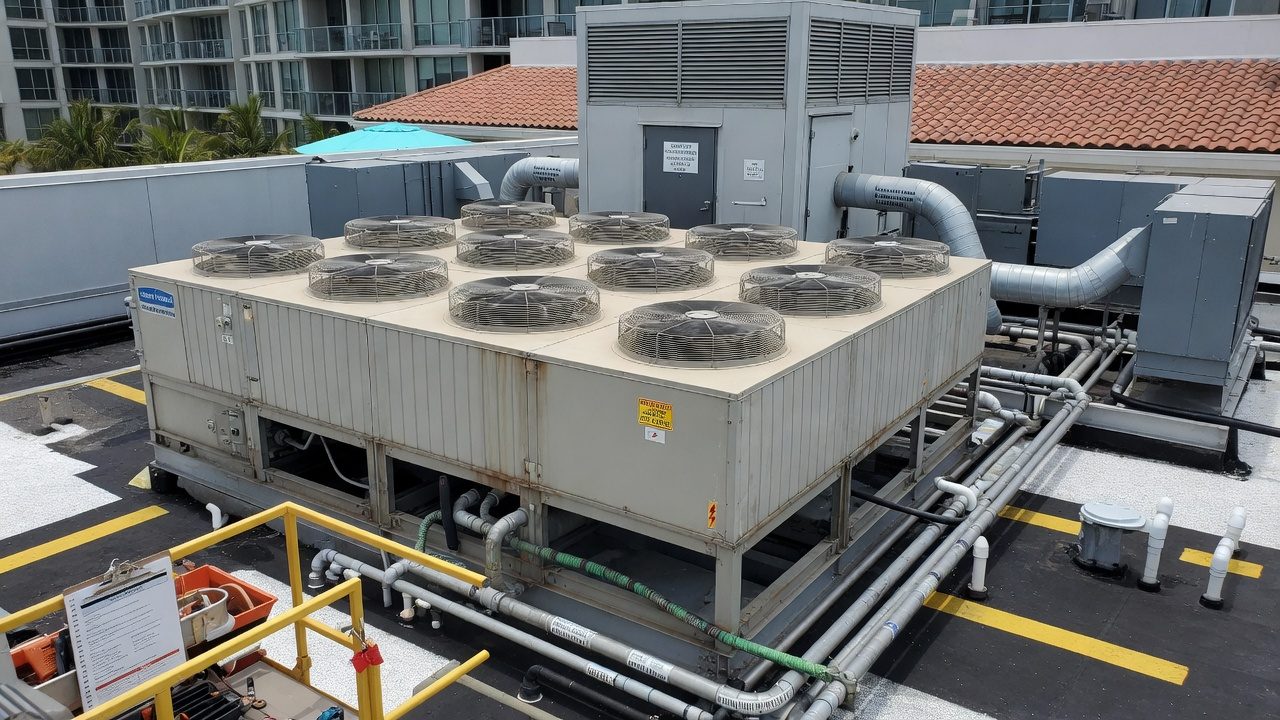
The setup is fairly straightforward. One or more large chillers or air handling units do the heavy lifting, producing conditioned air that gets distributed across the building through a duct network. Everything runs from a central point, which makes day-to-day operation relatively uncomplicated.
Where central AC really earns its place is in large, open spaces. Grand ballrooms, sprawling hotel lobbies and convention centres are all environments where you need to shift a lot of air quickly and keep temperatures consistent across a wide area. Central systems do that well.
Finally, don’t underestimate the advantage of familiarity. HVAC technicians across the UAE know these systems inside out, spare parts are easy to source, and properties with existing ductwork won't face the disruption and cost of starting from scratch.
Key differences between VRF (VRV) and central AC systems
Installation VRF (VRV) needs significantly less ductwork, takes up less space in the building, and generally causes far less disruption during installation. It also retrofits into existing properties more easily than central systems, which tend to require more invasive work to get in and running.
Energy efficiency This is where VRF (VRV) pulls ahead. Rather than running at full output regardless of demand, VRF (VRV) systems modulate refrigerant flow in real time, so a half-empty hotel floor on a quiet Tuesday uses a fraction of the energy it would on a full weekend. SEER ratings back this up, and for a property running 24/7, the difference on the electricity bill is significant.
Guest comfort A guest in a VRF (VRV)-equipped room controls their own temperature independently of every other room in the building. With central systems, you're largely maintaining a building-wide set point, this is fine for lobbies and corridors, less ideal for guests who run hot or cold.
Maintenance Central systems mean more components, more ductwork, and more opportunities for things to go wrong in hard-to-reach places. VRF (VRV) units have built-in diagnostics and simpler connections, so when something does need attention, it's usually faster to find and fix.
Scalability Adding rooms, reconfiguring a floor, or expanding into a new wing? With VRF (VRV), indoor units can be added or removed without touching the rest of the system. Central AC tends to need more substantial reworking whenever the building layout changes.
Operating costs VRF (VRV) typically costs more to install than a central system. Over time, though, lower energy consumption and less maintenance spend often shift the balance. For new builds especially, it's worth modelling the total cost of ownership rather than just the upfront number.
Which HVAC system is best for different hospitality applications?
The answer depends entirely on your needs. Let’s look at some different situations.
Boutique hotels are almost tailor-made for VRF (VRV). The ability to give each room its own climate control fits the personalised, considered experience these properties are selling. The indoor units are also discreet enough not to fight with interior design choices.
Luxury resorts often benefit from a hybrid approach. VRF (VRV) works well in guest rooms and premium spaces where individual comfort matters. For a grand ballroom or a large dining venue with high ceilings and heavy footfall, central AC may be the better fit for that specific space.
Serviced apartments tend to be a natural fit for VRF (VRV). Longer-stay guests have very different habits and expectations from hotel guests, and controlling their own environment is something they value. The energy efficiency also helps when utility costs are being managed per unit.
Restaurants and banquet facilities can go either way depending on layout. Open dining areas with lots of covers often suit central cooling. Private dining rooms, wine cellars and prep kitchens, for example, benefit from the zoning control that VRF (VRV) offers.
Mixed-use developments are arguably where VRF (VRV) makes the most sense of all. When you have a hotel, retail outlets, offices, and perhaps a gym all sitting under one roof, the cooling demands across those spaces vary enormously throughout the day. A single central system struggles to accommodate that flexibility in the way a well-designed VRF (VRV) setup can.
FAQs about VRF (VRV) and central AC systems
Are VRF (VRV) systems more energy efficient than central AC systems?
Yes, in most hospitality settings. VRF (VRV) systems use inverter-driven technology that adjusts output based on real-time demand, rather than cycling on and off at full capacity. This means less energy wasted conditioning empty or lightly occupied spaces. This is a significant advantage in hotels where occupancy varies considerably by time of day and season.
Which HVAC system offers better zoning control for hotels?
VRF (VRV) systems offer superior zoning control. Each indoor unit can be independently managed, so guests in their rooms can enjoy their personal settings, and the hotel lobby can be managed separately from the fitness centre. Central systems can incorporate some zoning, but it’s far less granular.
Is VRF (VRV) more expensive to install?
Generally, yes. Upfront installation costs for VRF (VRV) are higher than for a comparable central AC system. However, lower operating costs, reduced energy bills, and easier maintenance often mean VRF (VRV) delivers better value over the long term. For new builds in particular, the efficiency gains can offset the initial investment relatively quickly.
Which system requires less maintenance over time?
VRF (VRV) systems typically require less maintenance. They have fewer complex components, no extensive duct networks to clean, and come with built-in diagnostic features that make identifying and resolving issues faster and easier. Central systems involve more components and more ductwork, which means more regular servicing requirements.
About Daikin
When it comes to HVAC solutions in the UAE’s hospitality sector, Daikin has built a reputation for VRF (VRV) and central air conditioning systems designed for energy efficiency, comfort, and reliability.
Daikin’s UAE offering covers the full spectrum, from compact VRV systems suited to boutique properties to large-scale commercial HVAC solutions for major hotel complexes. Systems can integrate with building management platforms, giving operators centralised oversight of energy usage across their entire property.
Backed by a strong UAE dealer and service network, Daikin provides support from initial design through to ongoing maintenance, an important consideration in a climate where HVAC downtime is simply not an option.
Comparison summary
Factor | VRF (VRV) System | Central Chilled Water |
|---|---|---|
Zone-level control | Inherent — each indoor unit independently controlled | Achievable, but requires FCU thermostats and control valves per zone |
Simultaneous heating & cooling | Yes — heat recovery units can heat some zones while cooling others simultaneously | Requires a separate boiler or heat pump for heating; cannot do both simultaneously from one chiller |
Best suited to | Boutique to mid-size hotels, serviced apartments, extended-stay properties | Large full-service hotels, convention centres, resorts, mixed-use developments |
Plant room space required | Minimal — outdoor units distributed across roof/external areas | Significant — dedicated plant room required for chillers, pumps, and ancillary equipment |
Refrigerant pipe run limits | Yes — manufacturer-specific limits (typically ~165m height, ~1,000m equivalent length) | None — chilled water pipework has no comparable run-length restriction |
Compatibility with district cooling | No — VRF (VRV) cannot accept chilled water from an external source | Yes — chilled water infrastructure integrates directly with district cooling networks |
Part-load efficiency | Excellent — compressor modulates continuously; performs well at low occupancy | Good — improved significantly with variable-speed and magnetic-bearing chillers |
Fault tolerance | High — distributed plant means one outdoor unit fault affects only its served zones | Lower — central plant failure can affect the whole building; redundancy requires additional capital |
Long-term repairability | Good — components serviceable, but proprietary tools and trained technicians required | Very good — major components can be overhauled independently; skills widely available in market |
LEED / Estidama compatibility | Good — contributes to energy credits under both programmes | Good — contributes to energy credits under both programmes |