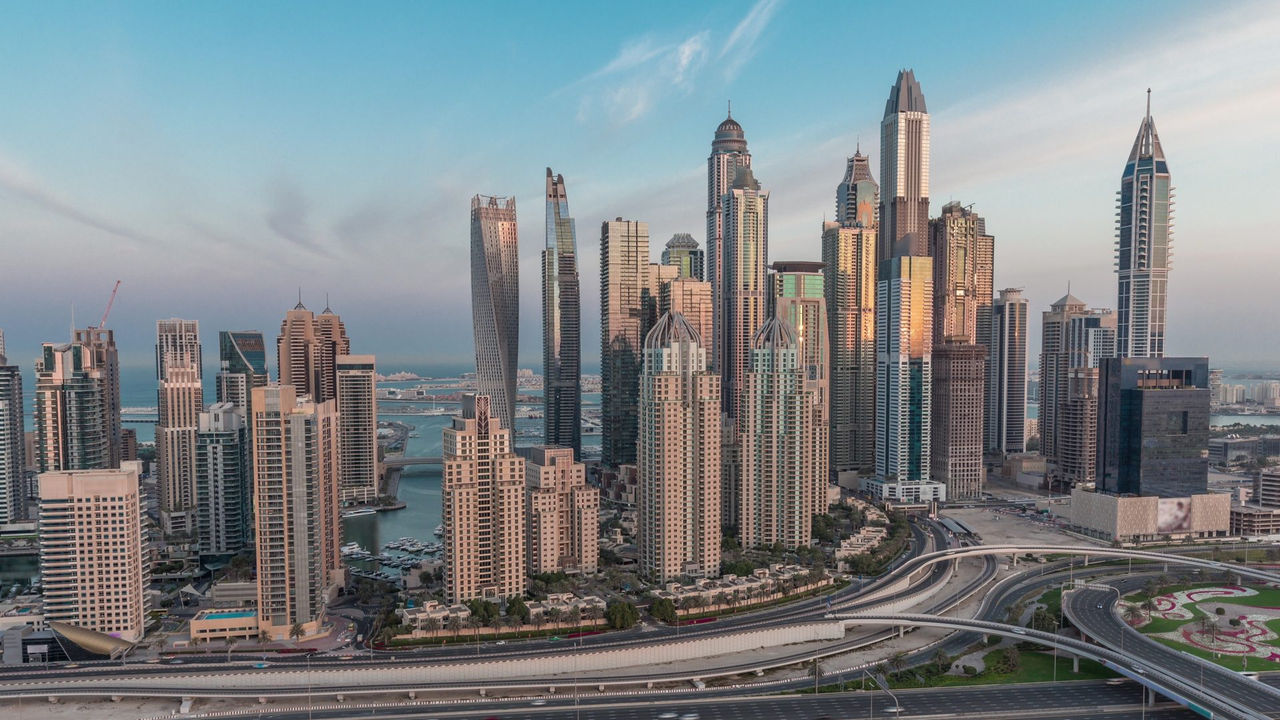
Dubai's summers are among the most extreme on the planet, with temperatures regularly exceeding 45°C. Cooling a single building in those conditions is manageable. Cooling thousands of them efficiently is a different problem entirely, which is precisely why district cooling now serves the majority of major developments across the city.
What is district cooling and how does it work?
District cooling is a centralised air conditioning system that produces chilled water at one central plant and distributes it through insulated underground pipes to multiple buildings within a development or neighbourhood. Rather than each building generating its own cooling, the entire district draws from one shared source.
The process runs in four steps:
- A central plant chills water to between 4°C and 5°C using large industrial chillers.
- The chilled water travels through an insulated underground pipe network to each connected building.
- An energy transfer station at each building passes the cooling into the internal air-handling system.
- The warmed return water flows back to the plant, where it is re-chilled and recirculated.
How is district cooling different from a normal AC unit?
A conventional split AC unit runs an independent refrigerant cycle inside each apartment, with a compressor mounted on the building's exterior. District cooling eliminates all of that. Buildings on a district cooling network require no outdoor compressors, no on-site refrigerant, and no building-level chiller maintenance. Cooling arrives at the building as a utility, much like water does.
Why do Dubai buildings use district cooling?
Two factors drive adoption: scale and sustainability. At the scale of a large development, one central plant running industrial chillers is 40% to 50% more energy-efficient than the same number of buildings each running individual units. That cuts peak electricity demand across the city's grid significantly. District cooling also supports the UAE Net Zero 2050 Strategy and Dubai's target of sourcing 100% of power from clean energy by 2050.
Dubai has set a formal target of meeting 40% of its total cooling demand through district cooling by 2030, up from under 20% today.
Which buildings and areas rely on it most?
Not every building type suits district cooling equally. The economics work best where demand runs high and constant: hotels that never switch off, hospitals requiring round-the-clock climate control, high-rise towers with hundreds of units pulling from the same source. Master-planned communities like Palm Jumeirah and JBR were designed around it from the ground up. Three companies supply most of Dubai, each operating within a defined concession area:
- Empower (Emirates Central Cooling Systems Corporation): Business Bay, DIFC, Jumeirah Beach Residence, Jumeirah Lake Towers, and Palm Jumeirah.
- Emicool: Dubai Sports City, Motor City, and parts of Jumeirah Village Circle.
- Tabreed (National Central Cooling Company): major city infrastructure including the Dubai Metro, plus select residential and commercial developments.
Which provider serves a building depends on the developer's concession agreement, not on resident or tenant choice.
How much energy does district cooling actually save?
The short answer is 40% to 50% compared with running individual split AC units across the same number of buildings. That figure comes from the scale advantage: large industrial chillers operate 30% to 40% more efficiently than small residential units, and consolidating demand into one plant eliminates the energy lost to dozens of separate refrigerant cycles running simultaneously.
At the city level, that translates directly into lower peak electricity demand, which is one reason Dubai and Abu Dhabi have both made district cooling central to their energy strategy.
What role does thermal energy storage play?
Thermal energy storage is a technique where a district cooling plant chills water or produces ice during overnight off-peak hours, then draws on that stored cooling to meet daytime demand rather than running chillers flat-out during the hottest part of the day. This smooths the load on the electricity grid, reduces the plant's peak power draw, and lowers operating costs. It is a key reason why district cooling systems can sustain efficiency gains even when summer temperatures drive cooling demand to its highest.
How does district cooling change the way residents pay?
Unlike a Dubai Electricity & Water Authority (DEWA) electricity bill, a district cooling bill has two separate components. The consumption charge is variable: it tracks the actual cooling used, measured in refrigeration ton-hours (RTh), and changes month to month depending on how much the AC runs. The capacity charge is fixed: it reflects the size of the cooling connection allocated to a unit, measured in refrigeration tons (RT), and is billed monthly regardless of consumption. On top of those two sit a meter maintenance fee, a fuel surcharge, and 5% VAT.
Empower, Dubai's largest provider, publishes a consumption rate of 0.568 fils per RTh and a demand charge of AED 750 per month per RT.
Why does the bill stay high even when a unit is empty?
The capacity charge does not pause when a unit sits vacant. It covers the infrastructure reserved for that connection, not the cooling actually consumed. An owner who leaves a property empty over summer still pays for the capacity allocated to it. This is one of the more common sources of confusion for new residents and first-time buyers.
District cooling versus chiller-free apartments
Chiller-free is the term used in Dubai for buildings where cooling is provided through the building's own central chiller plant, with the electricity cost covered by the landlord as part of the service charge rather than billed separately to the tenant. The resident pays rent and a DEWA bill for general electricity and water; cooling does not appear as a separate line item.
District cooling buildings work differently. The tenant receives a separate monthly bill from the provider, covering both the consumption and capacity charges described above. That additional cost line surprises many tenants relocating from chiller-free buildings, particularly in summer when consumption charges climb.
The trade-off is reliability and efficiency: district cooling plants are maintained centrally to a regulated standard, whereas chiller-free buildings vary considerably in equipment age and upkeep.
How can a renter check which system a building uses?
The fastest way is to ask the landlord or agent directly and request written confirmation before signing. A tenancy contract for a district cooling building will typically name the provider. Checking with the building's facilities management team or searching the property on Empower's, Emicool's, or Tabreed's online portals will also confirm coverage. RERA's standard tenancy contract requires cooling arrangements to be disclosed, so any reputable agent should be able to answer clearly.
How is district cooling regulated in Dubai?
The Regulatory and Supervisory Bureau (RSB) is Dubai's governing body for the water and electricity sector, and district cooling sits firmly within its remit. Every provider must hold an RSB license, operate within an approved tariff structure, and meet published standards for metering and billing. Concession agreements tie each provider to a specific geographic area, which is why a resident in a district cooling building has no choice of supplier.
Any tariff increase requires RSB sign-off before it takes effect. The bureau publishes its full regulatory framework online, including RD10 (tariffs) and RD06 (metering and billing), giving residents access to the same rules their provider is bound by.
Dubai has set a formal 40% district cooling target for 2030, written into policy rather than left to market forces. Growth here is a government priority.
What comfort and reliability benefits do residents get?
Centralised plants deliver more consistent cooling than building-level chillers, which can fluctuate in performance as equipment ages or maintenance slips. Because district cooling uses chilled water rather than refrigerant gas circulating through individual units, there are no outdoor compressors on balconies or rooftops, which means significantly less noise. Buildings also benefit from cleaner facades and more usable outdoor space.
Reliability is a practical advantage too. A central plant has redundant equipment and dedicated engineering teams on call around the clock. A failed compressor in a conventional system means one building loses cooling; a district cooling plant is designed so that no single failure affects supply.
About Daikin
Daikin MEA has spent decades engineering climate systems across the Middle East and Africa, from individual residential units to large-scale commercial installations. The company brings that depth of expertise to every stage of a building's cooling infrastructure, including the kind of centralised systems that define how modern developments manage energy. For residents and developers navigating district cooling in Dubai and beyond, Daikin MEA offers both the technical knowledge and the regional experience to make informed decisions.
Frequently asked questions about district cooling in Dubai
Is district cooling cheaper than a normal AC unit?
At the building level, district cooling costs are broadly comparable to conventional AC running costs, though the two-part billing structure means residents pay a fixed capacity charge every month regardless of how much cooling they use.
Can a resident opt out of district cooling in their building?
No: if a building is connected to a district cooling network, all units within it are supplied by that system and there is no option to install an independent alternative.
Which company provides district cooling in my building?
That depends on your development; Empower, Emicool, and Tabreed are the three main Dubai providers, and your tenancy contract or facilities management team will confirm which one serves your building.
Why do district cooling bills spike in summer?
The consumption charge rises sharply as units run longer and harder during peak heat, even though the fixed capacity charge remains constant throughout the year.