Introduction
The National Centre of Meteorology (NCM), the UAE’s official weather authority, forecast a 47°C high for Dubai on August 2, 2025. Overnight lows above 30°C are common through July and August, so switching the air conditioner off rarely feels like an option. Plenty of households simply leave it running from May to October.
That habit raises fair questions about cost, wear and comfort. The Dubai Electricity and Water Authority (DEWA), the emirate’s government-owned utility, has said air conditioning can account for up to 70% of a household’s electricity bill. With that much money tied to one appliance, it pays to know what non-stop cooling really does. This guide covers the risks, the costs and the settings that work best in the Gulf climate.
Is it safe to run an AC all day in Dubai’s heat?
Yes, running a well-maintained air conditioner all day in Dubai is safe, and modern units are built to handle it. Problems tend to come from neglect, poor sizing or ageing equipment rather than long running hours.
Inverter technology explains why. An inverter air conditioner is a unit whose compressor varies its speed to match cooling demand instead of switching fully on and off. Once the room reaches its set temperature, the compressor slows to a low, steady pace and holds it there. Daikin’s adaptive inverter systems are designed to reduce cooling energy use by up to 30% compared with non-inverter systems.
Safe all-day operation still depends on four conditions:
- Clean filters: DEWA advises cleaning them at least once a month during summer.
- Correct sizing: an undersized unit runs at full output and never catches up.
- Sound wiring: older circuits can overheat under constant heavy load.
- Unit age: DEWA puts the optimal lifespan of an AC at around ten years.
Older fixed-speed systems need closer attention. A fixed-speed unit runs its compressor at full power until the target temperature is reached, then shuts off completely. In 45°C heat, that repeated stop-start cycle adds strain, which makes regular servicing even more important.
Why do so many Dubai residents run their AC continuously?
Most Dubai residents run their AC around the clock because the heat and humidity barely ease, even after sunset. The NCM regularly forecasts coastal humidity of 75% to 90% on summer nights, and a flat left without cooling for a few hours quickly turns into a hothouse.
Four practical reasons keep units running:
- Holding comfort: concrete walls and glazing soak up heat all day and release it overnight, so rooms warm up fast once cooling stops.
- Controlling moisture: relative humidity measures how much water vapour the air holds compared with its maximum. Indoor levels above 60% encourage mould, so many people leave the AC on to keep the air dry.
- Protecting pets and belongings: animals, electronics and wooden furniture all suffer in a sealed, overheated home.
- Avoiding the restart: pulling a hot room back down to 24°C works the compressor harder than holding a steady temperature.
The mould concern is well founded. Dubai specialist Vivoteq reported a 70% rise in enquiries over summer 2024, while Rentokil Boecker linked part of the problem to AC units switched off during holidays.
What does running your AC 24/7 do to your electricity bill?
Leaving your AC on day and night can increase your electricity bill. But being switched on does not mean it uses full power all the time. An inverter AC can slow down once the room is cool and use less electricity to keep it comfortable.
For example, take a three-bedroom villa in The Springs with three AC units. The table shows the estimated yearly cost of keeping the same home equally cool with each type of AC. It compares the two types—not the cost of leaving the AC on all day versus using a timer.
- Standard AC without an inverter (R-410A): Full-year AC cost AED 8,840; annual saving —
- Daikin inverter AC (R-32): Full-year AC cost AED 5,870; annual saving AED 2,970
- Estimated saving: Full-year AC cost AED 2,970 less; annual saving Approximately 34%
That is about AED 2,970 less a year on cooling—roughly one-third off the AC electricity cost in this example. Inverter AC can save electricity not just during hot summer days, but also at night and in milder months when less cooling is needed. R-32 is the cooling gas used in these Daikin units; the saving comes from how efficiently the whole AC works, not the gas alone. Keeping every room cool all day is still not always the cheapest choice.
These estimated AC electricity costs use assumed cooling needs and published efficiency figures that still need confirmation for the exact units. Your savings will vary with how you use your AC and your electricity tariff.
Does running your AC non-stop cause wear and tear?
Yes, non-stop use adds wear, though poor maintenance does far more harm than long running hours. The compressor, the pump that circulates refrigerant around the system, carries the heaviest load, followed by the fan motors and electrical parts.
Start-ups cause much of the strain. Fixed-speed units draw a surge of power each time the compressor kicks in, whereas inverter models ramp up gradually and then tick over at low speed. A steadily running inverter often ages better than an older unit switching on and off all day.
Watch for these signs of excess wear:
- Weak airflow or warm air from the vents
- New rattling, buzzing or humming
- Ice forming on the indoor coil
- Water dripping from the indoor unit
How does continuous use affect filters and coils?
Continuous use clogs filters and coils faster, and that build-up pushes energy use up. The US Department of Energy says swapping a dirty filter for a clean one can lower an air conditioner’s consumption by 5% to 15%.
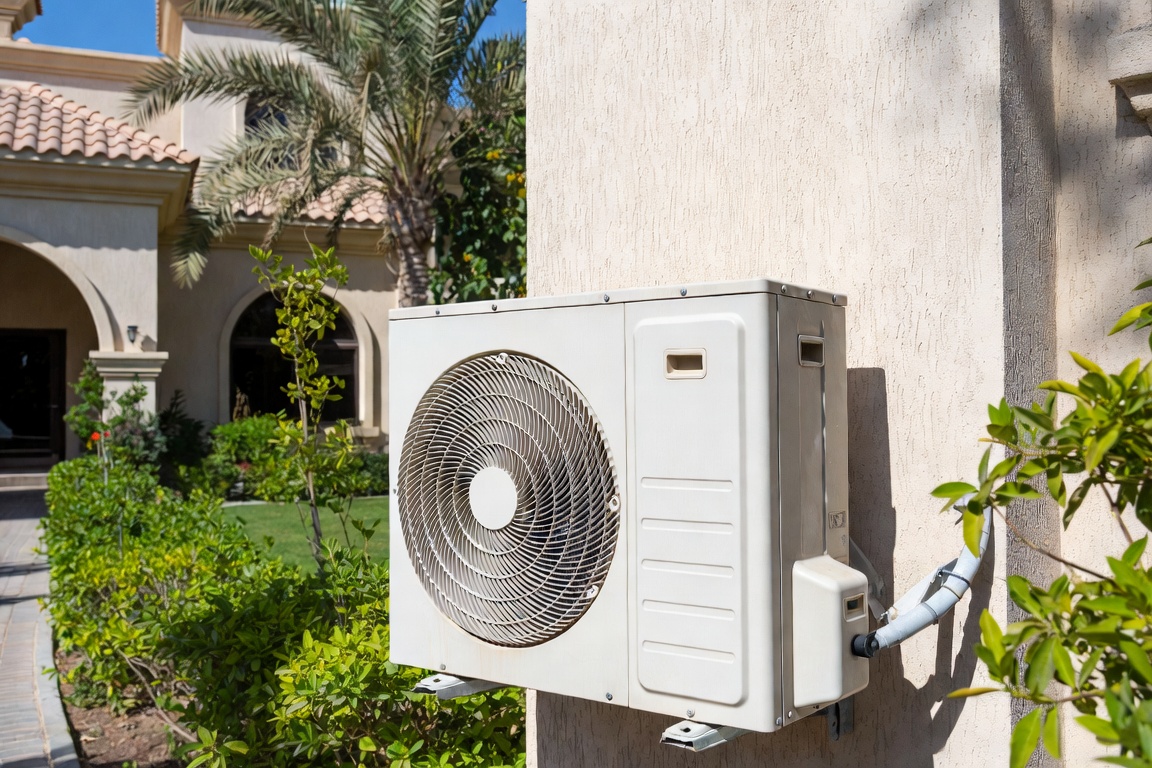
The evaporator coil is the indoor component that absorbs heat from the room, while the condenser coil releases that heat outdoors. Both gather dirt, and Dubai’s frequent dust storms coat outdoor condensers especially quickly.
A simple routine keeps them clear:
- Clean or replace indoor filters monthly during summer.
- Clear sand, leaves and debris from around the outdoor unit.
- Book a professional coil clean as part of each service.
Should you leave the AC on when you travel?
Yes, keep the AC running at a higher setting rather than switching it off while you travel in summer. Mould specialists quoted by Khaleej Times recommend 26°C to 28°C for an empty home, which keeps humidity under control without cooling rooms nobody is using.
Before you leave:
- Raise the thermostat to 26°C to 28°C, or set a programmable timer.
- Leave internal doors open so air circulates.
- Close blinds and curtains to block solar heat.
- Activate DEWA’s Away Mode, a feature in the DEWA app that emails daily or weekly usage reports while you are away.
What AC temperature and settings work best in Dubai?
24°C on auto mode works best for most Dubai homes, and it’s the setting DEWA officially recommends. Auto mode lets the unit adjust its output and switch itself on and off as the room needs.
Fine-tune comfort with these settings:
- Dry mode: removes moisture at low compressor speed, useful on humid nights.
- Sleep mode: raises the temperature gradually overnight on most units.
- Ceiling fans: DEWA notes fans use about as much electricity as a light bulb and make higher settings feel cooler.
- Avoid dropping to 18°C to cool a room faster. The unit won’t cool any quicker: it simply runs harder for longer.
How can you run your AC efficiently all day?
Efficient all-day cooling starts with the right equipment: DEWA says replacing ACs past their ten-year lifespan with 4- or 5-star rated models can cut cooling consumption by up to 25%.
Then follow these steps:
- Draw blinds and curtains on sun-facing windows during the day.
- Seal gaps around doors and windows with weather stripping.
- Fit a smart thermostat to schedule temperatures by room.
- Run washing machines and dishwashers outside DEWA’s midday peak hours.
- Book a professional service before summer starts.
About Daikin
Daikin has been designing air conditioning systems since its founding in Japan in 1924, and today ranks among the world’s leading HVAC (heating, ventilation and air conditioning) manufacturers. Its Middle East and Africa regional headquarters sits in Jebel Ali Free Zone, Dubai, supporting customers across the GCC and Africa. If you’re running your AC 24/7 in Dubai, Daikin’s inverter range is engineered for steady, efficient cooling through the hottest months.
Frequently asked questions about running your AC 24/7 in Dubai
Is it cheaper to leave the AC on or turn it off and on?
For inverter units, holding a steady 24°C usually costs less than repeatedly cooling a hot room from scratch.
What is the ideal AC temperature in Dubai?
DEWA recommends 24°C on auto mode as the best balance of comfort and energy use.
Why does my AC run non-stop and never cycle off?
Inverter units run continuously by design, but constant full-power running usually signals dirty filters, low refrigerant or an undersized unit.
How often should an AC be serviced in Dubai?
Book a professional service before every summer, and every six months if your AC runs around the clock.