Poor placement of the outdoor AC unit is one of the most overlooked reasons air conditioners in the UAE underperform. The system might be new, correctly sized, and well-maintained, but if the outdoor unit is baking in direct afternoon sun or hemmed in by walls on three sides, it cannot release heat efficiently.
In a climate where temperatures routinely exceed 45°C and summer runs for close to six months, that inefficiency has real consequences: cooling output drops, energy bills climb, and compressor lifespan shortens. This guide covers what homeowners, facility managers, and contractors need to know about positioning outdoor units correctly under UAE conditions.
Why does outdoor AC unit placement matter in the UAE?
Placement matters because the outdoor unit is responsible for releasing heat from inside your home to the surrounding air. When placement restricts that process, the entire system works harder, consumes more electricity, and wears out sooner. In a country where air conditioning runs almost continuously for six months of the year, that inefficiency compounds quickly.
The UAE's conditions make this especially significant. Outdoor temperatures regularly exceed 45°C in peak summer. Sandstorms deposit fine dust inside outdoor units and through ventilation gaps. In coastal cities such as Dubai Marina, Jumeirah, and Abu Dhabi Corniche, salt-laden air accelerates corrosion of metal components, including copper refrigerant lines, electrical contacts, and fan motor housings. No other single installation decision affects long-term AC performance as consistently as where the outdoor unit is sited.
What is the outdoor unit and what does it do?
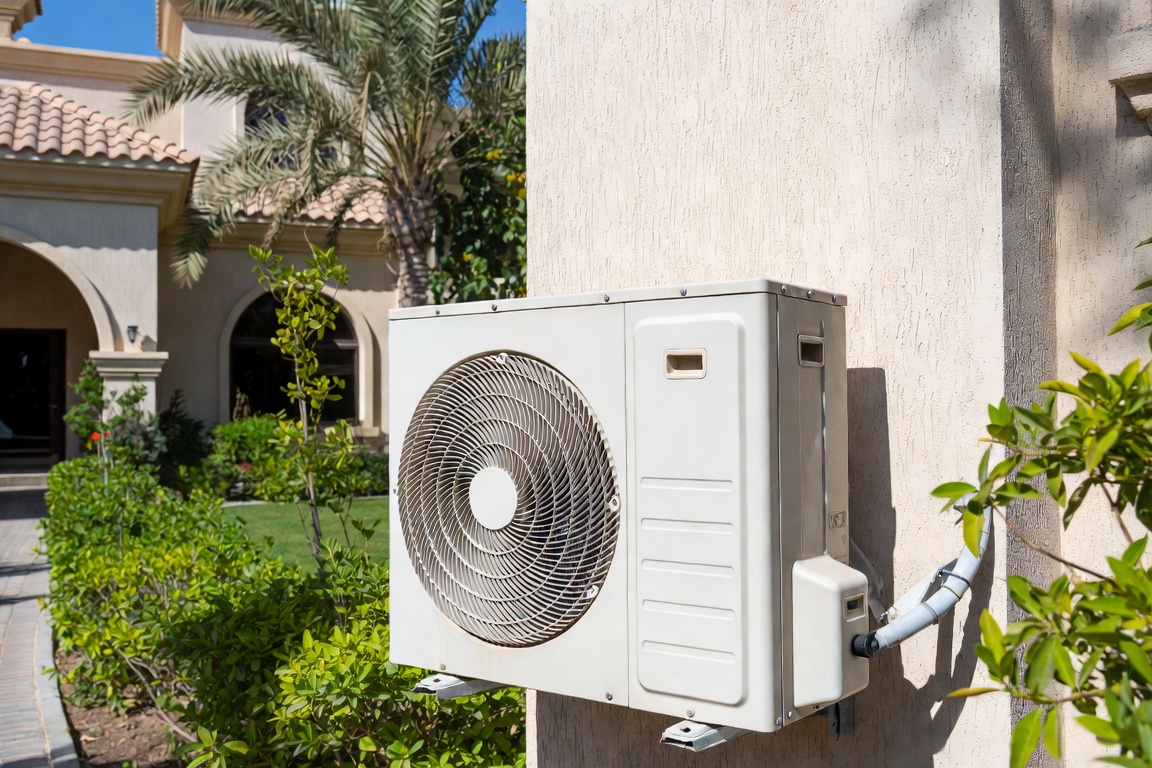
The outdoor unit, commonly called the condenser, is the component of a split air conditioning system that expels heat collected from inside your home to the outside air. It houses the compressor, the condenser coil, and a fan that draws ambient air across that coil to carry heat away. For the process to work properly, the unit needs a supply of ambient air cooler than the refrigerant inside the coil, plus enough open space for that air to circulate freely. Restrict either, and the unit operates under elevated pressure and temperature, reducing efficiency and accelerating compressor wear.
How does sun exposure affect outdoor AC unit performance?
As condensing temperature rises, evaporating temperature rises and cooling capacity drops. To achieve maximum cooling capacity, the location selected for outdoor unit should fulfill all the requirements as per the manufacture installation manual.
A shaded outdoor unit runs measurably better. The US Department of Energy puts the efficiency gain at up to 10% – and that figure was calculated in temperate conditions. In the UAE, where summer ambient air already sits above 45°C, the penalty for direct sun exposure is considerably steeper.
The problem is heat-on-heat. When solar radiation heats the unit's metal casing, the air immediately around the condenser coil gets hotter than the surrounding ambient air. The compressor now has to work against higher pressure to push refrigerant through the system. More strain, more electricity, more wear. Compressor failure is the most expensive AC repair there is, and sustained sun exposure is one of the more reliable ways to bring it on early.
Wall orientation compounds this. West-facing positions take the worst of it, absorbing intense afternoon sun during the hottest part of the day. North- or south-facing locations receive far less direct exposure and are the better choice wherever the building layout allows.
Should the outdoor unit be fully shaded?
Partial shade is the target, not full enclosure. A louvred canopy, an open-sided overhang, or a slatted pergola can block direct sun without choking the airflow the unit depends on. Solid enclosures are genuinely counterproductive: the unit exhausts warm air, and if that air has nowhere to go, the condenser ends up working in its own heat. That is worse than leaving it in direct sun with full clearance.
How much clearance does an outdoor unit need for proper airflow?
Most split-system outdoor units require a minimum of 30cm of clear space on all sides and 50cm from the service side (compressor side) and at least 150cm of the clearance is needed Infront of the outdoor fan side. Some manufacturers specify more. Check the installation manual for the specific model, as requirements vary.
The reason the numbers matter: the condenser fan draws air in through the sides of the cabinet and expels it upward. Block the intake and the unit cannot pull sufficient air across the coil. Block the top and warm exhaust air recirculates straight back into the intake, compounding the heat load. In UAE summer conditions, where ambient air is already punishing, either scenario pushes the system hard in exactly the wrong direction.
What counts as an airflow obstruction?
Anything within the minimum clearance zone that restricts air movement. The most common problems are:
- Solid walls or fencing on one or more sides
- Dense shrubs or plants that have grown into the clearance zone
- Stored items pushed up against the unit
- Decorative screens or trellis panels fitted around the unit
- A second outdoor unit positioned too close
Slatted or mesh screens are not automatically safe. If they reduce air velocity noticeably, they function as an obstruction regardless of how open they look.
Ensure that there is no obstruction of air flow into or out of the unit. Remove obstacles which block air intake or discharge. The location must be well ventilated, so that the unit can draw in and distribute plenty of air thus lowering the condensing temperature.
How does UAE dust and sand affect outdoor unit placement?
UAE dust contains silica particles fine enough to bypass standard filters and settle directly on condenser coils. Once there, they act as insulation, reducing the coil's ability to transfer heat into the air moving across it. The compressor works harder to compensate, which raises energy consumption and accelerates wear on the system's most expensive component.
Placement can limit the problem. Positioning the unit above ground level helps, as dust concentrations are highest near the surface. Avoid siting units downwind of construction activity or open sand, a relevant consideration across large parts of Dubai, Abu Dhabi, and the Northern Emirates. A single sandstorm can load a coil to the equivalent of several weeks of normal accumulation, so post-storm cleaning should be treated as a standalone maintenance event rather than something to carry over to the next scheduled service.
Does coastal location change where the unit should go?
Yes. In areas such as Dubai Marina, Jumeirah, and Abu Dhabi Corniche, prevailing winds carry airborne salt that settles on condenser fins and corrodes the aluminium. Units in these locations benefit from positioning that limits direct sea-wind exposure without sacrificing airflow clearance. Elevated or wall-mounted placements facing away from the coast reduce salt accumulation. Anti-corrosion coatings and more frequent maintenance inspections are necessary regardless of orientation.
Where should outdoor units be placed on balconies and rooftops?
Balconies and rooftops both work: the conditions, not the location type, determine whether the placement is good or bad.
On a balcony, the typical problem is enclosure. Surrounding walls and railings limit airflow, and if the exhaust fan has nowhere to push warm air, it recirculates back into the intake. Position the unit as close to the open edge as the space allows, with the exhaust facing outward. Check that the balcony structure can carry the weight before anything else.
Rooftops usually offer better natural airflow, but the exposure is harsher. Wind is stronger, dust accumulation is faster, and coastal units face more salt air than at lower levels. Mount the unit on a raised platform to keep it clear of standing water and debris after rain. In high-wind areas, proper anchoring is not optional.
Can multiple outdoor units be placed near each other?
They can, with adequate separation. The practical issue is exhaust air from one unit entering the intake of the next, which raises the effective temperature each unit operates against. So arrangement should be back-to-back or facing each other with minimum clearance 200cm as per most manufacturers specify; some require more. Where space is tight, angling units so their exhausts point in different directions is the simplest fix.
About Daikin
Daikin MEA engineers outdoor units built to handle the conditions that undermine performance across the region: sustained high ambient temperatures, fine desert dust, and coastal salt air. Every unit is designed to deliver reliable output against these variables, not just under controlled test conditions. For homeowners and contractors making decisions about outdoor AC unit placement in the UAE, Daikin's regional team offers guidance on siting, installation, and maintenance schedules suited to local conditions.
Frequently asked questions about outdoor AC unit placement in the UAE
Does direct sunlight damage an outdoor AC unit?
Not immediately, but sustained direct sun raises operating temperatures and pressure, accelerating compressor wear over time, and also cooling capacity drops.
Can I cover my outdoor AC unit to protect it from sun and dust?
Only with a breathable, open-sided cover: solid enclosures trap exhaust heat and cause more damage than direct sun would.
How often should an outdoor unit be cleaned in the UAE?
Every three to four months as a minimum, and within 24 hours after any significant sandstorm.
What are the signs an outdoor unit is poorly placed?
Reduced cooling output, rising energy bills, frequent system shutdowns, and visible dust or debris buildup on the condenser coil.