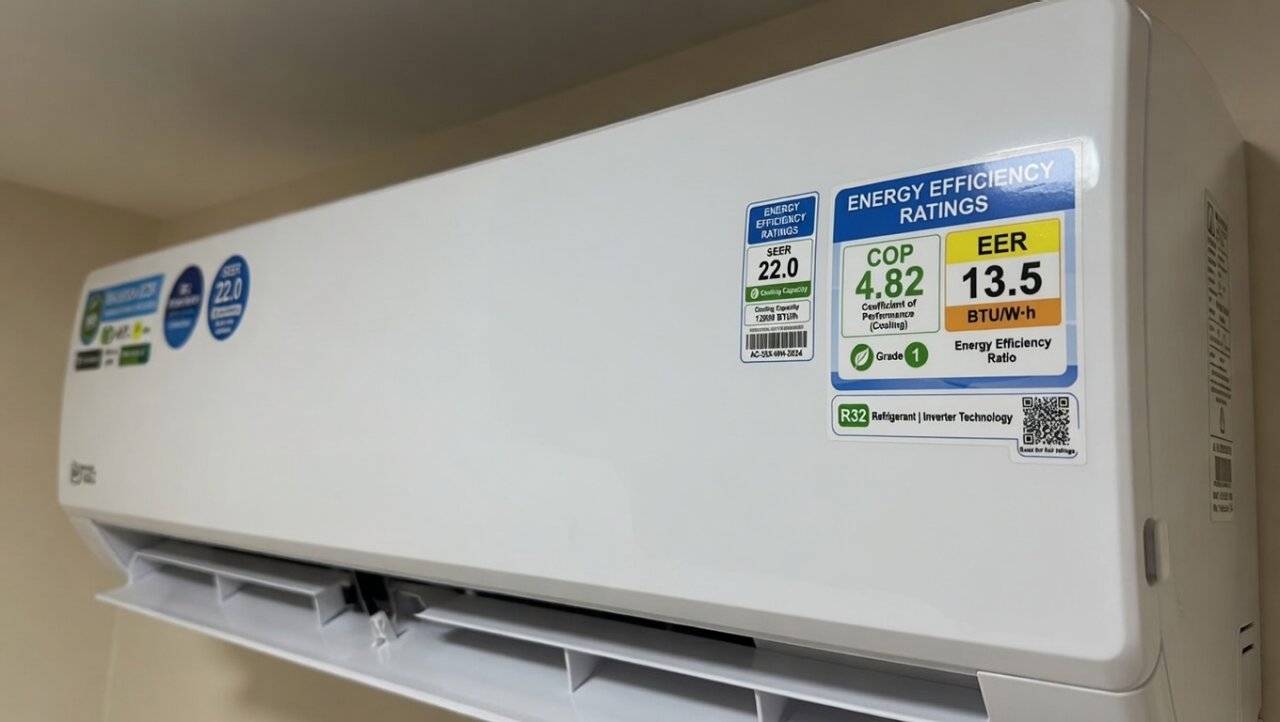
In a time when energy prices are soaring and people are becoming more environmentally aware, selecting the right HVAC system can no longer be thought of as merely getting a device that delivers cold air. It is about figuring out the long-term operating expenses and the environmental impact of your choice. If you go to a shop or just look at a technical manual, you will encounter a soup of acronyms: COP, EER, and SEER.
While these figures are meant to assist buyers, they may be confusing. Is a COP of 3.5 more efficient than a SEER of 15? Why does one label contain EER while another completely omits it? Deciphering these figures can help you make the best purchase decision. Relying on a system indicator that does not truly reflect your climate, such as the severe heat characteristic of the Middle East, might lead to repeatedly higher utility bills than expected.
COP vs EER vs SEER: How to accurately compare HVAC efficiency metrics
Fundamentally, all three indicators, COP, EER, and SEER, essentially measure the same thing: the amount of cooling (or heating) produced relative to the electrical energy consumed. In other words, they indicate how much useful output you get from each unit of electricity consumed. Nonetheless, they are different in how and under what conditions they are measured:
COP (Coefficient of Performance): Used for both heating and cooling, it provides a snapshot of efficiency at any given point in time.
EER (Energy Efficiency Ratio): It is a measure of the cooling efficiency at a particular high-temperature operation point.
SEER (Seasonal Energy Efficiency Ratio): It is a measure of cooling efficiency throughout a typical cooling season, factoring in the variations of outdoor temperatures.
Comparing them accurately means going beyond the headline number and considering the conditions in which the unit will operate.
What is COP (Coefficient of Performance)?
The Coefficient of Performance (COP) is probably the easiest among the three metrics to understand. Simply put, it is the ratio of heating or cooling output to electrical energy consumed. Highlights of COP:
Unitless ratio: Since it is the comparison of similar energy units (e.g., Watts of cooling vs. Watts of electricity), a COP of 4.0 means the system delivers 4kW of cooling for every 1kW of electricity consumed.
Versatility: EER and SEER are mainly used for cooling, whereas COP is the common heating metric for heat pumps.
Instantaneous measurement: Generally, the COP demonstrates the efficiency of a device only at a single temperature point under stable conditions (steady-state). As such, it may be seen as an excellent proxy for a machine's intrinsic efficiency, but it does not capture how performance varies as outdoor temperatures fluctuate.
What is EER and SEER?
Although COP is a global physical ratio, for commercial and residential air conditioning, EER and SEER are more common, especially in areas where mainly cooling is required.
EER (Energy Efficiency Ratio)
EER indicates the cooling efficiency of an AC unit at one particular set of conditions: typically an outdoor temperature of 35°C (95°F).
The ‘stress test’: Imagine EER as the sprint metric. It shows you how effective the system is when running at full capacity on a hot afternoon.
Consistency: Since it is determined at a specific temperature, EER is very trustworthy for comparing units in hot climates, for example, the Middle East, where the unit hardly ever experiences mild days during summer.
SEER (Seasonal Energy Efficiency Ratio)
SEER was created to give a real-world perspective on efficiency over a period of time.
Variable testing: Rather than a single temperature, SEER is determined by operating the unit at different outdoor temperatures (between 18°C and 40°C) and also taking into account the start-stop losses of the compressor.
The marathon metric: SEER indicates the typical efficiency of a product throughout the whole season.
Inverter advantage: SEER levels are normally considerably greater for inverter technology units, as these can change speeds to suit the weather. On the other hand, EER does not always reflect this advantage very well.
Key differences between COP, EER, and SEER
To be able to compare these metrics fairly, it's necessary first to understand their differences in terms of applications and measurement methods.
COP is a technical, instantaneous ratio that measures the heating and cooling output of heat pump systems. It is calculated by dividing output Watts by input Watts, making it the most mathematically direct comparison of energy transfer.
EER is a cooling metric measured at one fixed high temperature under steady-state conditions. It is calculated by dividing the cooling output in BTUs by the power input in Watts. This makes it the most reliable metric for units operating under constant, high-heat stress.
SEER stands for Seasonal Energy Efficiency Ratio and represents an average seasonal figure of cooling efficiency. It is designed for variable-temperature climates. It is calculated by taking the total seasonal BTU cooling output and dividing it by the total Watt-hours of energy used over that same period. This gives a real-world average suited to temperate climates where temperatures vary.
It's really important to understand this difference. A unit can achieve a high SEER rating simply because it performs well at 24°C. However, if its EER is low, then it means that the unit struggles once temperatures exceed 45°C. A unit with a high EER is a reliable performer on the hottest days of summer.
How to choose the right efficiency metric
The best metric ultimately depends on your situation.
1. Consider your climate
Extreme heat: Consider focusing on EER. Because your unit will be functioning at its hottest level for the longest time, it makes sense to know how well it performs under such conditions. A high SEER might be misleading if the seasonal average includes temperatures much lower than what you actually experience.
Moderate/four-season climates: Here, SEER is the more relevant metric. It gives a good indication of the savings you can expect during the mild spring and autumn months when the AC is not forced to run at full capacity.
2. System type
Heat pumps: If you want to heat your home with a heat pump during winter, the coefficient of performance (COP) is the most important metric to keep your heating bills from skyrocketing when the weather gets very cold.
3. Usage patterns
Commercial/constant use: Since loads are constant in server rooms and other 24/7 applications where the system rarely idles, the energy efficiency ratio (EER) is generally more important.
Home use: A household AC is unlikely to run at the same temperature all day, so SEER — especially for inverter-technology systems — will more closely reflect real savings on monthly energy bills.
FAQs about HVAC efficiency metrics
Which is better: EER or SEER?
Neither is inherently better than the other, as they serve different purposes. EER is more suitable to quantify maximum capacity under very high temperature conditions, whereas SEER is more suitable to quantify average efficiency during a season with temperature fluctuations. In regions with a hot climate, a high EER is more likely to be a good sign of quality.
What is considered a good SEER rating?
The majority of standard air conditioning units these days have a SEER rating of 13 or 14. High-efficiency ones, however, usually fall within the range of 16 to 23 and beyond. In fact, in numerous areas, a rating higher than 18 is usually deemed very good, and it is likely to reduce your energy usage considerably.
Is COP more accurate than SEER?
COP is more of a scientific measure, as it directly compares energy input to energy output. SEER is a better money-saving measure for homeowners because it accounts for the reality of changing weather.
Do higher ratings always mean lower energy bills?
Overall, yes. Nevertheless, if a unit is not the right size (too big or too small for the room), even a high SEER rating alone will not stop the bills from being high. Proper installation and regular maintenance are just as important as the rating on the label.
About Daikin
Daikin is a world leader in connected HVAC solutions, with a vision of addressing two core challenges: keeping spaces comfortable while protecting the environment. Over more than a century, Daikin has pioneered some of the world's most efficient air conditioning technologies, such as developing the R-32 refrigerant and the most advanced inverter compressors.
Globally, Daikin boasts a workforce of over 98,000 employees. We take great pride in designing systems that not only meet but often go beyond the global efficiency standards, whether it is raising the COP for heat pumps or reaching the highest EER ratings for the very challenging Middle Eastern climates. When you choose Daikin, you are choosing a legacy of innovation, reliability, and a greener future for the planet.