There is more and more concern these days about the quality of the indoor air we are breathing. There are a number of factors at play here, and a number of different solutions. One solution which is becoming increasingly popular is ultraviolet light (UV).
This used to be something you would only find in high-risk environments like hospitals and laboratories, but it’s now finding its way into more mainstream usage, such as residential and commercial HVAC systems. All with the goal of creating a healthier indoor space.
UV light works somewhat differently to other filters. Instead of filtering particles after they circulate, UV systems work more proactively. They neutralise microorganisms at their source, which is particularly important inside HVAC units where moisture can create conditions for microbial growth.
At Daikin we have been pioneering HVAC solutions for over a century, and today have more than 100,000 employees around the world who are committed to providing the best possible HVAC systems for residential, commercial, and industrial. In this article, we will discuss how a UV light works in HVAC, the different types of UV lights used in HVAC systems, as well as their benefits and limitations. So let’s get started.
How does a UV light work in HVAC?
The kind of UV lights you generally find in HVAC systems rely on UV-C light. This is a specific wavelength of UV light which has germicidal properties – in other words, it can disrupt the DNA and RNA of microorganisms like bacteria and viruses. When these organisms are exposed to UV-C light, they lose their ability to reproduce.
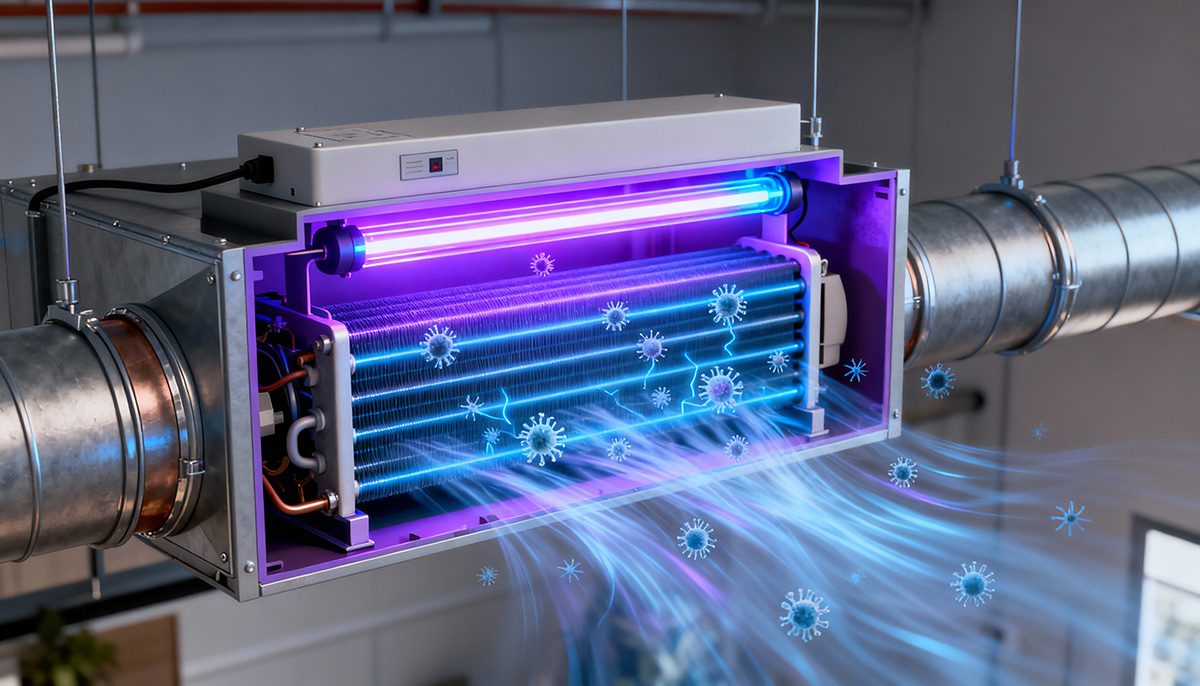
UV lights are usually installed inside the air handler or ductwork of an HVAC system. They are often near the evaporator coil, drain pan, or within the return air stream. Because these locations are prone to getting moist (which encourages mold growth), they are prime locations for UV light.
It works as follows: Air circulates through the system and UV-C light either treats the air directly or continuously irradiates surfaces inside the unit. As mentioned, once this light is present it stops microorganisms from being active, helping keep a cleaner system while also limiting the spread of contaminants through conditioned air.
Types of UV lights used in HVAC systems
There are two main types of UV lights used in HVAC systems:
The first is coil sterilisation UV lights. These shine on the evaporator coil and surrounding components. Because coils are frequently damp during operation, they are a prime breeding ground for mold and bacteria. Coil sterilisation lights keep these surfaces clean.
The second type is air-stream UV light. These are installed inside ductwork to treat air as it moves through the system and expose airborne microorganisms to UV-C light during circulation. The exposure time is short but it can still significantly reduce microbial loads over time.
You will find in some advanced installations a combination of both approaches, so you get both surface protection and air treatment all in one.
Benefits of using UV lights in HVAC
Better air quality is clearly the main benefit of UV lights in HVAC systems. Once you stop microorganisms before they circulate, you can reduce airborne bacteria, mold spores, and viruses. By doing this, you’re reducing the chances of conditions that can contribute to respiratory irritation and unpleasant odors.
Another major advantage is reduced mold growth on coils and other internal components. When coils are cleaner you’re getting healthier air and also ensuring the HVAC system is working at peak performance. UV lights help prevent buildup of biofilm, supporting consistent airflow and temperature control.
Once your system is working at high efficiency you are also using less energy. This is because a clean system does not need to work as hard to heat or cool a space.
Finally, it’s often reported that you get fewer stale odours once you have installed UV lights. The smells are usually microbial growth inside the system, particularly in humid environments.
Limitations and safety considerations
So there are limitations to the effectiveness. It can be said that UV lights do work very well but they are not a complete solution on their own. They are not able to remove dust or allergens or particulate matter from the air. So UV should be used along with air filters and not as a full replacement.
Safety is another important consideration. UV-C light can be harmful to skin and eyes if directly exposed. This means professional installation is vital to ensure that UV lights are completely enclosed within the HVAC system. Because the placement of the bulb and how the light is shielded is so critical, incorrect installation can reduce performance or create maintenance issues. It should also be noted that UV bulbs do degrade over time and must be replaced according to manufacturer guidelines if they are to remain effective.
FAQs about UV lights in HVAC systems
Do UV lights in HVAC systems kill mold and bacteria?
Yes, UV-C light can neutralise mold, bacteria, and some viruses by damaging their genetic material. They do not necessarily eliminate all microorganisms but through continuous exposure they reduce growth and spread.
Are UV lights safe for people and pets?
When properly installed inside an HVAC system, UV lights are safe. The light is contained within the unit and does not enter living spaces. Direct exposure, however, should always be avoided.
How long do HVAC UV bulbs last?
Most HVAC UV bulbs last between 9,000 and 12,000 hours, which equates to around one year of continuous use. Regular replacement is essential to maintain effectiveness.
Can UV lights improve HVAC energy efficiency?
Indirectly, yes. By keeping coils and internal components cleaner, UV lights help the system operate more efficiently. This reduces energy consumption and can extend the lifespan of equipment.
About Daikin
Daikin is a global leader in advanced HVAC solutions, with decades of experience in developing technologies that support indoor air quality. The company’s approach recognises that clean air is a fundamental part of modern living and working environments.
Daikin’s HVAC systems are engineered to integrate seamlessly with indoor air quality enhancements, including UV light technology. By combining robust filtration, precise climate control, and compatibility with germicidal solutions, Daikin supports healthier indoor spaces across residential, commercial, and industrial applications.
Through ongoing innovation and a focus on performance-driven design, Daikin continues to set industry benchmarks for HVAC systems that deliver cleaner and more comfortable air.